Club & Tournaments History
- E.J. (Ted Hart) & Andrew Hempstead
The Club
100 Years of Camaraderie and Tradition
“I still try to get out for a game when I can.
—Rob Crosby in 2010, club member since 1930
Although the Banff Springs Golf Course is open to public play, today Banff Springs Golf Club membership is restricted to town of Banff + Bow Valley residents and is limited to 200 adults and 50 juniors.
The club was formed in 1911, and the formation coincided with the opening of the original Banff Springs Golf Course. By this time, Banff had grown into a bustling tourist town with a growing number of middle-class merchants and professionals, many of whom had come from larger eastern Canadian cities where golf was already popular and had a following with the social strata to which they aspired. Not surprisingly, several of these residents were eager to form a club to play the new course, and they held an organizational meeting at the Banff Springs Hotel on July 13, 1911.
The group decided that the club should be organized as the Banff Springs Golf Club. Gentlemen resident members (those living in Banff) would pay a fee of $15 per annum and lady resident members $5 per annum, while all non-resident members would pay $10 per annum. Hotel guests were "to have the privileges of the club" at a cost of $0.50 for a round of 18 holes, $1 for one day, or $5 for one week.


A Change in Ownership
In 1927, when the Canadian Pacific Railway acquired ownership of the Banff Springs Golf Course from the government, there was an included clause critical to the future of the Banff Golf Club: "The Company [CPR] agrees that the playing club already established at Banff and known as the Banff Golf Club shall be permitted to hold playing competitions at reasonable times, subject to all competitors paying the regular fees and complying with the regulations in force." This coincided with the opening of the new Stanley Thompson course, with Thompson himself personally involved in discussions between the club and the railway company regarding the club's future.
Revised Constitution
The revised 1929 constitution called for a board of directors of seven members, five of whom were to be elected by the membership and two of whom appointed by the CPR. The directors would elect from amongst themselves a president, a vice-president, and a secretary-treasurer, and could appoint a ladies' committee to assist in matters pertaining to women members and the club's social affairs. It also provided that the club would pay a nominal $1.00 per annum fee to the CPR and that club members were allowed to use the clubhouse, grounds, and course. The 1929 constitution stated that there were to be five classes of membership: "honourary members," awarded lifetime membership exempt from all fees; "special members," who were also exempt from green fees but paid club fees; "gentlemen members," who were residents of Banff National Park for at least six months every year; "lady members," who were also park residents for six months every year; and "junior members," between the ages of 12 and 18 whose had a parent who was a member or who were sponsored by the board of directors.
1930s
By 1932, a mixed foursome competition had been added to the year's events as well as the Challenge Trophy (now known as the Thompson Shield), for the team matches between the club and the hotel. To enliven club competitions, skills challenges were added to the regular events. The approaching and putting competition required the contestants to pitch and putt from distances of 150, 75, and 20 yards, while the long-driving competition was based on the aggregate yardage of three drives. In the Ladies Division, the Priscilla Hammond Memorial Trophy was awarded for the club championship in 1933. Other ladies’ competitions mirrored those in the Men's Division; the Mrs. Harmon Approach and Putt was introduced in May 1933, and the Mrs. Dell Brewster Long-Driving Competition in June 1934.
Post World War II
In 1946, the constitution was revised to tighten the residency requirements for membership, requiring applicants to have resided in Banff National Park for 12 months prior to eligibility and necessitating their residency for 8 consecutive months each year. Prospective members also had to be known to the proposer and to at least two members of the board of directors. In order to keep club members informed of activities and competitions and to promote attendance, a newspaper column entitled "Tee Topics," written by Ethel Knight, began its long run in the Crag and Canyon in 1952.
Changes in the way the club operated began to occur after Ivor Petrak was promoted to manager of the Banff Springs Hotel in 1971. An amendment to the club's constitution clarified the position of lady members, and in 1975, Petrak agreed to a system of accounts for club members that would allow them to charge for food and drink in the clubhouse. In 1976, an amendment to the club's constitution created a new class of "non-playing" membership in response to the desire of some Banff residents to become members of the Banff Springs Golf Club for the social status and prestige it conferred without having to play golf.
Membership Fees
As members of the Banff Springs Golf Club play on a course that is owned by a company (Oxford Properties) that, in turn, leases the land from the federal government, the board of directors has little control over membership fees. When the Banff Springs Golf Club was formed in 1911, the charter members living in Banff paid $15 for the season, while the 12 non-resident members paid $10. By 1929, when the Stanley Thompson course had been completed, the membership fee had two components—a green fee, which was collected by the club on behalf of the CPR, and annual dues. In 1929, gentleman members paid $25 for green fees and $6 in annual dues. Lady members who were the wives, daughters, or sisters of gentleman members paid $12 for green fees and $3 dues, while green fees for “unrelated females” were set at $15. By 1976, there was no inequity between the fees paid by women and men.
Today, Club membership dues are the same for Juniors, Men and Ladies.
Club membership provides for:
Unlimited participation in Men’s league, or Ladies’ league or Junior instruction/tournaments + Adult Mixed league
Participation in Tournament dinners and prizing
Participation in inter-club tournaments against such other Clubs as: Fairmont Jasper Park Lodge; Priddis Golf & Country Club, Calgary; and Stewart Creek, Canmore.
Season-end Tournament & Final Banquet dinner gala
Golf Canada membership & insurance
And more.
Fairmont Green Fees vary slightly for members depending on the privileges chosen:
Adult full-access (incl. the Tunnel 9 + Stanley 18 + all practice facilities)
Adult full access w only Stanley 10 pass
Stanley-Junior full-access
Tunnel-Junior (9-hole Tunnel course only + practice facilities privileges)
The Tournaments
Although the Banff Springs Golf Course officially opened in 1911, the first recorded competition didn’t take place until 1915, when a handicap tournament was organized for club members by resident professional Bill Thomson. The Crag and Canyon subsequently reported that "a more interesting game has never been held on the Banff links." The winner was local hotelkeeper Lorne Orr, and the prize was two golf clubs handmade by Thomson and taken from his small professional shop. The idea proved so popular that management decided to emulate it with a match play competition; the winner would receive the Banff Springs Hotel Cup, donated by F.L. Hutchinson, manager-in-chief of hotels. In 1919, Lorne Orr, who was now the president of the Banff Springs Golf Club, donated a silver cup for the first season-long competition in the club's repertoire. The competition was held on the first and third Thursdays of each month, and members chose their best eight scores from ten rounds; the competitor carding the lowest total score net of handicap won the cup.
Today, in addition to being one of the few clubs in North America where the men’s club champion is decided by match play, the club also boasts annual events with long, storied histories. The Captain’s Pin dates back to 1923, the season-ending Tombstone Tournament to 1925, and the family-run Gourlay Scotch Best Ball to 1947. The Thompson Shield is a match play event that pits members against hotel staff, and the Bray-McCullough is named for a prominent past member and a superintendent who enjoyed a long history with the club. Women members have been competing for the club championship since 1933 and celebrate the club's history with other trophies, such as the Memorial Plate and the Ethel Knight Memorial.
In addition to club competitions, the Banff Springs Golf Course has hosted numerous tournaments and events over the last century, open to golfers from around the world. The most prestigious of these was the competition for the Prince of Wales Cup, which was donated to the Banff Springs Golf Club in 1924. The course has also been showcased to millions of television viewers through Shell's Wonderful World of Golf series and the Telus World Skins Game. Events like Golf Week were developed by the CPR to encourage visitors to use the course, while the Oilmen’s Tournament is a private affair for oil industry executives dating back to the early 1950s.
Men’s Division
Since Hugh Gourlay won the inaugural men’s championship in 1923, the names of over 40 different members have been engraved on the club’s most sought-after trophy. Many of these same members have claimed other major trophies, with Gourlay, Charlie Reid, and Lou Crosby sharing many honours through to the 1940s. Bob Bray won 16 championships between 1946 and 1970, after which no one golfer dominated club competition until the early 1990s, when Rob Wilson, followed by Seiji Miyazoe, both former junior members, joined the adult ranks.
Men’s Club Championship
Traditionally considered the purest form of the game, the annual men’s club championship is match play. The 16-man field is decided by gross score from a stroke play qualifier held early in each golfing season. The reigning club champion is automatically seeded 1st, while the remaining 15 players are seeded by qualifying score. All matches are decided over 18 holes except the 36-hole final, usually held in late August.
Competition began for the Birks Trophy, donated by the jewelry company Henry Birks & Sons and emblematic of the club championship, in August 1923. In that first event, and after many weeks of match play, Hugh Gourlay beat Jock McCowan 8 and 7 to be crowned the inaugural club champion. Gourlay, who had been one of the best players since the early days of golf in Banff, virtually owned the Birks Trophy in the late 1920s. However, by the early 1930s, Charlie Reid, a young apprentice who had come from Medicine Hat to work for Gourlay at the King Edward Drug Store in 1922, was coming into his own and challenging his boss. Reid first won the club championship in 1931, but in 1935, he was defeated in the final 5 and 3 by Doug Crosby, son of prominent local golfer Lou Crosby.
In 1936, Reid did not advance to the final round of the club championship, as that honour went to the two Crosbys, with father defeating son. In 1937, however, the elder Crosby finally had his day against Reid and defeated him to win the club championship. The next year, Reid turned the tables and was named champion over Crosby. In 1939, Doug Crosby ascended the winner's podium. When the two archrivals, Lou Crosby and Reid, met again in the final in 1940, it was the elder Crosby who prevailed. Two years later, Lou Crosby began an unprecedented string of four club championship wins. In 1942, he had to once again meet the challenge of one of the members of his own family, in this case his son Rob, who had tied his father for low qualifying and then lost to him on the 35th hole of the final.
The winningest champion in the history of the club is Bob Bray, who won the club championship 16 times between 1946 and 1970. Through the 1950s and ’60s, Bray had competition from Garry McCullough (son of superintendent Casper McCullough), George Christou, Myron Kowalyk, Jock McCowan Jr., Forbes Duke, Gordon Blakemore, Jim Morrison, Ted Robley, and Jimmy Webb (who wrested the championship from Bray in 1954). The passing of Bob Bray in 1975 and the aging of some long-time club members provided opportunities for a new, younger generation of club champions in the 1970s and ’80s. However, no one player would again dominate the winner's podium for the men’s club championship as Lou Crosby and Bob Bray had in previous decades.
Beginning in 1973, the men’s club champion was presented with the Kennedy Trophy, named for Dr. Ernest Kennedy, who had been instrumental in securing an agreement between the club and the CPR for playing privileges when the Thompson course opened in 1928, and who had passed away the previous year; Jack Wilson was the first club champion to receive the new trophy. In 1978, Brian Burke, a relatively new club member, defeated veteran member Norman Knight on the 38th hole to claim the club championship. The following year, Bernie Gould, a former sports director at the Banff Springs Hotel, withstood the challenge of another young player, Bruce Beattie, to claim the title. In 1980, Toru Miyazoe defeated Chuck Wickson for the honours, while Brian Hann and Al Robinson both claimed back-to-back titles in the 1980s.
Rob Wilson won his first club championship in 1993, two decades after his father’s victory, and has gone on to claim victory five times since. Beginning in 2004, and after winning many junior club championships, Seiji Miyazoe won four club championships over six years. From 2010 to 2025, Bobby Larkin has won the Club Championship 10 times against stiff competition while also winning stroke-play, Presidents Cup, Bray-McCullough and more.
Men's Stroke Play Championship (2024+)
Re-started in 2024 with Trophy and event sponsors Monod’s Sports and Rude Boys; the Club again plays a multi-day, stroke-play championship. Starting on a Wednesday Men’s night, the best 24 stroke-play, gross scorers make the cut to a second round of play on Thursday, and the top 12 men with 2-night combined scores advance to a third round on Friday. The top 3-round combined score is the Champion.
Men's Senior Club Championships
The Banff Springs Golf Club has three tournaments for its more senior members. Lou Crosby put up the Crosby Trophy for senior competition in 1946 and won the first year's event himself. Since 1997, the Senior Men’s Club Championship has been a 36-hole medal and handicap event for members aged 50 and older. Bernie Gould won in 1997, the first of three consecutive titles. Stewart Fernie won in 2003 and Tadashi “Sho” Mabe won four times between 2004 and 2008. Former men’s club champions Toru Miyazoe (2009) and Randy Fleet (2010) also have their names engraved on the trophy.
Members aged between 40 and 49 have been playing for the Middle Age championship since 2004, while the Super Seniors Trophy, established in 2002, is for those aged 65 and older. Rob Crosby won the Super Seniors in 2005, 70 years after his name was etched onto the Ward Cup for juniors. Other names on the Super Seniors Trophy that have been associated with the club for many decades include Wally Anderson (2002 and 2007) and Bernie Gould (2009)
Bray–McCullough
The year 1975 saw the passing of two of the most important men involved with the club and course—Bob Bray, who had won the club championship 16 times, and Casper McCullough, the long-time superintendent. To recognize the outstanding contributions of these two men, club member Dr. Ray Fleming came up with the idea of creating a new event in their memory, the Bray–McCullough Tournament. Club members taking part could use their best three scores out of five on identified weekly men's day rounds (today, the event has been shortened to the best two of three rounds). The annual general meeting of 1975 officially adopted the idea and supported the purchase of trophies for winners of the low gross (the Bray) and low net (the McCullough).
Captain’s Pin
One of the oldest club tournaments is the Captain’s Pin. The event has been held annually since 1923, when club captain Hugh Gourlay put up a gold tie pin which was to be competed for every week during the season and worn by the winner until his score was beaten. The member who won the pin the most times during the year had the right to keep it over the winter. Because Gourlay held the position of captain, his pin was soon being referred to as "the Captain's Pin." Today, the Captain’s Pin is an 18-hole handicap event with the format selected each year by the men’s captain. Rather than a tie pin, the winner has his name engraved on a large trophy donated by Bernie Gould in 1982.
Good, Bad, and Ugly
From its inception in the early 1990s, the Good, Bad, and Ugly Tournament has been a popular but often testing day of golf that traditionally culminated in downtown Banff with dinner at Athena Pizza and Spaghetti House. For the event, the first six holes are played from the gold tee boxes to easy pin placements, the next six holes are played from the white tee boxes to moderately difficult pins, and the final six holes are played from the black tee boxes to pin placements that range from difficult to almost impossible.
Thompson Shield – Challenge Trophy
A few weeks after the new Stanley Thompson course opened in 1928, members of the Banff Springs Golf Club challenged hotel staff to a match. The hotel staff carried the day, helped by hotel manager A.H. Devenish and future superintendent Casper McCullough, who was employed as a greenskeeper at the time. The following year, Stanley Thompson himself donated a shield to what became known as the Challenge Trophy. The members won in 1929, and again the following two years, after which the hotel staff won ten years running. Since 1942, the hotel and club have claimed victory an equal number of times. When there was no more room for names on the original shield, it was replaced by the Thompson Shield. Although the event has always been match play, handicaps are now used, and most of the hotel staff members involved are from the golf course staff. Three points are awarded per match (one for the front nine, one of the back nine and one for the 18). This remains a hotly contested, yet fun event, for season-long bragging-rights!
President's Cup
Beginning in 1927, the winner of the President’s Cup was awarded a pewter cup. The club has three of the original cups, although there is no record of who they were awarded to. Since 1934, winners have had their names inscribed on a large cup that is still used today. Early winners with their names engraved on the larger trophy were the club’s best golfers—Charlie Reid in 1934 and 1935; Lou Crosby in 1936, 1938, and 1939; and Doug Crosby in 1937.
Today, the President’s Cup is a 36-bracket sign-up, match-play event with full handicaps, requiring consistent play throughout the season for success. In the last decade, Lawrence Davidson (2002 and 2003) and Richard Monette (2004 and 2010) have been repeat winners, while other names engraved on the cup include Ian MacDonald (1998), Stu Fernie (1999), Keith Higginbottom (2001), Chris Lambe (2006), Rich Mottram (2007), Tadashi Mabe (2008), and Bobby Larkin (2009).
Melissa's/Spence Brothers Memorial Cup (with golf Calcutta*)
Doug & Bob Spence were long-time members with BIG personalities. They also owned a men’s wear store on Banff Avenue and were leaders on the Club’s Board. When in the role of Men’s Captain, information on Men’s league events and sign-up for the various tournaments was posted in the store window! As they got older they started The Spence Brothers tournament, and after they passed away, the annual memorial tournament in their honour evolved with the post-tournament event hosted at Mellissa’s Mis-Steak restaurant. On the Monday in advance of the Tournament Men’s league members would meet at the Spence household, and later at Melissa’s, to draw the 2-man teams (High/Low) out of a hat and then make bets on which team would win in a golf Calcutta approach. Stroke play, best-ball format. Proximity and other fun prizes for all continue to be part of the format today with brothers, sister and the next generation of Spence family participating.
H.A. Gourlay Trophy
In 1935, charter member Hugh Gourlay put up a trophy for 72 holes of medal play, with Gourlay himself winning the initial event. Doug Crosby won the following year, with Charlie Reid and Doug’s father, Lou Crosby, also winning over the next decade. The competition continued using this format until 1947, when Gourlay, wishing to improve the camaraderie of the event, changed it to the Gourlay Foursome (now called Gourlay Scotch Best Ball), in which two-man teams competed for a golden putter. Teams consist of a low and a high handicapper drawn from a hat. Traditionally, both partners drive from each tee, then each plays a second shot with the other’s ball. After the second shot, a choice is made regarding which ball to complete the hole with. Alternating shots, then continue with the ball of choice, although slight variations on this format have appeared in recent years. This is one of the most popular events of the golfing season, with excellent attendance and a great selection of donated prizes.
Bammer Bowl
"Bammer" (Dave Raham) was a local personality and long-time member who passed in 2016. However, he spent a lot of time on the Banff Springs Golf Course. He worked the refreshment carts amongst other areas and was often found on the course playing. His philosophy on golf was to HaVe FuN! In 2017 the Club started an annual tournament in his honour.
Members invite guests who are friends of Bammer’s to play as their partner.
This recent annual event features lots of "skill" prizes and non-skill prizes. All Par 3's have KP's with a larger than normal KP Pool & Deuce Pot open to all players - members & guests! Low Handicappers (1-8) Play Blacks, 9-17 play Whites, 18+ Golds. Everyone plays the Heritage Tee on Cauldron! Long Drives, Long Putts, and more.
2-Man Teams, Best Ball, Handicapped.
Tombstone
The Tombstone Tournament, usually held in the fall, has been played since 1925. Each golfer adds his handicap to the par of the course. Wherever his ball lies after the allotted number of strokes have been taken, the golfer leaves a marker with his name on it (a “tombstone”). Players with strokes remaining after putting out on the 18th hole continue to the 1st hole. The player who advances his marker the greatest distance around the course is declared the winner. The Tombstone Tournament was designed to give higher handicappers an opportunity to win. This did indeed occur, with Jim Brewster, one of the club's strong supporters but far from its best golfer, carrying off the laurels at the inaugural Tombstone event in 1925, as reported in the Crag and Canyon:
As the players bringing up the rear of the Tombstone competition at the Banff Golf Club topped the rise towards the 16th green, the little tombstones dotted the landscape, showing the "death" of a goodly number of golfers. Then they saw more on the 17th and on the last, one lone little stone one foot from the 18th hole — on it Jim Brewster's name. He "died" here. But being the last of the band of fighting golfers, he won the trophy.
Most Improved
The Banff Springs Golf Club has been awarding the Dr. Norman J. Quigley Memorial Trophy for the year’s most improved men’s golfer since 1977, when it was won by Grant Baudais. Quigley was a local dentist renowned for his love of the game. (The area in front of the second set of fairway bunkers on today’s 18th hole is known to older members as “Quigley’s Corner,” for the doctor’s tendency to use this area for his approach shot to the green). The winner is determined at the end of the golfing season using a formula recommended by Golf Canada that calculates a handicap-based “improvement factor” for each golfer.
Other Trophies
In 1965, club members (and business partners) Jack Wilson and Gord Dorian put up the Wilson–Dorian Trophy, with Wilson himself carrying off the honours of the first year’s competition. In the 1980s, the Wilson–Dorian Trophy was replaced by a new event, sponsored by Jack Wilson, Chuck Wickson, and Ed Shenher, known as the Triangle Cup (now discontinued), which was based on 54 holes and held over three weekends in September. It was much enjoyed, with a horse race, parimutuel betting, and other novelties, including the presentation of a gold jacket in the manner of the Masters, to the winner.
Malcolm Tapp put up a trophy in his own name in 1973 to replace the Calgary Brewing & Malting Co. Limited Trophy, which was donated by Calgary’s largest brewery at the time and presented to the inaugural champion, Hugh Gourlay, in 1925. Play for Tapp’s trophy was over the July 1 weekend based on 36 holes of handicap play—Jack Wilson was the first winner. With the retirement of the long-time professional, the Malcolm Tapp Trophy was replaced by the new Doug Wood Trophy in 1989.
In 1970, Min Johnston, along with her son Jerry, presented the Walter Johnston Trophy to the club in memory of her husband for four-man team total score play. Both trophies have since been retired.
For many years the Club has run a two-round total score, handicapped Stableford competition – a tournament that continues today.
Ladies Division
In the earliest years of club competition, the two daughters of club member Dr. Gilbert Atkin, Gladys and Janet, were perennial champions, and Barbara Whyte was the dominant golfer through the 1940s, ’50s, and into the ’60s. In the 1960s and ’70s, Doris Bray, wife of men’s champion Bob Bray, was the woman to beat, while Debbie Mullins dominated through the 1980s. More recently, Sharon Phillips has had her name engraved on most of the club’s most important trophies.
Ladies’ Club Championship
The Priscilla Hammond Memorial Trophy has been awarded to the ladies’ club champion since 1933. The trophy, donated by the Hammond family to honour their young daughter, an excellent athlete and aspiring golfer who died suddenly just after graduating from university, quickly became the most coveted trophy in the club. The original rules of the match play competition were not put in writing until 1951. In 1976, the club championship reverted to medal (stroke) play, with the winner determined over 54 holes played over three days. This was changed to 36 holes over two days in the 1990s; ties are to be broken by an 18-hole playoff. Flights are determined by handicap, with the championship flight comprising eight players. In addition to the club champion, prizes are awarded to the 2nd and 3rd best cumulative scores, as well as to flight winners and the lowest overall net.
In 1933, two years after the Ladies Division was officially formed, Marion Crosby, daughter of charter member Lou Crosby, was crowned club champion. Janet Atkin won five of the first eight club championships, including a string of three victories beginning in 1935 (she would later marry one of the best young male golfers in the club, Doug Crosby).
In 1941, a young accounting clerk with the Dominion Parks Branch, Ethel "Tillie" Knight, who had joined the club as a junior in 1928, won the club championship but was challenged by another of Dr. Gilbert Atkin’s daughters, Gladys, who won the trophy in 1943 and 1944. The two girls were the best of friends and, like most club members, participated in other sports together. The Crag and Canyon account of the 1945 competition provides an insight into their friendship:
Ethel Knight defeated Gladys Atkin on the 19th hole of the Banff Springs Golf Course to win the Hammond golf trophy and the club championship. Both Ethel and Gladys are well-known members of the Ski Runners of the Canadian Rockies, and golfing is their summer training for keeping in condition for skiing. Ethel (better known to her friends as Tillie) is secretary of the Ski Runners and Gladys has been a ski guide and instructor at Sunshine and Temple Lodges in the Rockies.
Knight, along with Barbara Whyte and Doris Bray claimed 31 club championships combined between 1941 and 1978; Whyte, an assistant postmistress, won a record 11 club championships between 1946 and 1968; Doris Bray, wife of men’s champion Bob Bray, captured the crown 12 times between 1961 and 1981 (the last two after the passing of her first husband and after remarrying fellow club member Elwyn Smith), while Knight captured the last of her eight titles in 1975, 34 years after defeating her friend Gladys Atkin for her first championship.
Debbie Mullins was crowned ladies’ champion for six consecutive years between 1983 and 1988, while in the ’90s, Judy Tennant and Barb Alexander dominated the winner’s podium. The 1991 ladies’ champion was Junko Miyazoe, whose husband, Toru, had won the men’s division in 1980 and whose son, Seiji, would go on to win multiple championships. Sharon Phillips has dominated the ladies’ club championship in recent years, claiming the title seven times since 2001.
Ladies' Senior Club Championships
Handicaps are used to determine ladies’ senior (50 and over) and super senior (65 and over) champions. Seniors play from the gold tees and super seniors from the red tees for this 18-hole competition. The Seniors Trophy dates to 1980, when it was won by Grace Charlton, who also won it the following year. Other names include Erna Forbes (1981), Mel Ferrari (1985 and 1999), Doris (Bray) Smith (1986), Kay Monod (1988 and 1996), Marion Gundry (1990), Judy Tennant (1995 and 1997), Pat Langridge (2000), Holly Wilcox (2005), Karen Frey (2003 and 2009), Marjorie Holland (2006), Laurie Anderson (2007 and 2008), and Anne Goulet (2010).
W. Thomson Trophy
The original Banff Springs Golf Course professional, Bill Thomson, devoted a great deal of his time to ensuring the success of the club, especially with regards to the Ladies Division. After retiring, Thomson returned for an annual visit to Banff to play a round and visit old friends; he cemented his relationship with the club in 1951 when he contributed the W. Thomson Trophy to the Ladies Division for 18 holes of scratch play. The initial Thomson Cup for ladies was won by Florence Lonsdale in 1951, with perennial club champion Barbara Whyte winning in four of the following five years. In later years, a second level of competition for the cup was added, based on handicap rather than scratch play. The trophy was retired in 1979.
Charlton Cup
Sponsored by Charlton Resorts, the Charlton Cup was introduced in 1990 to replace the W. Thomson Trophy, which had been retired over a decade earlier. It is an 18-hole medal play event.
Brewster Challenge Cup
In 1971, Dell Brewster continued a family tradition of support for the Ladies Division when she donated the Jim Brewster Challenge Cup, replacing a shield dating to 1918 (of which little history is known). Ladies Division members Doris Bray, Grace Charlton, and Emma Anderson met with Brewster and developed a 54-hole event to be played with full handicap over three days in one week. It was initially won by one of the club’s newer players, Marion Gundry. The rules in 1971 stated that, in the event of a tie, there would be an 18-hole playoff. Before the tournament begins, each player pays $2 and draws a name from a hat for her “horse” in the "Horse Race." At the conclusion of the tournament, the money is distributed 50%-30%-20% to the 1st-, 2nd-, and 3rd-place finishers.
Sowden Trophy
The Sowden Trophy, for women golfers with handicaps between 30 and 36, was introduced in 1959 by club member Jennifer Sowden. It was a nine-hole handicap competition; the player with the lowest net score was declared the winner (and it could only be won twice by the same woman). In 1980, the event was changed to an 18-hole competition.
Mrs. Dell Brewster Long-Driving Competition
The club’s first ladies’ long-driving championship was held on June 6, 1935, at the height of the Great Depression—and its was won by its sponsor, Dell Brewster. The small, compact trophy now holds the names of many multiple club champions, including Ethel Knight, Barbara Whyte, Doris Bray, and Judy Tennant. Official rules set in 1952 stated that the winner was to be declared by adding the distance of three drives over three selected rounds during the season. While it may seem odd that this event, along with a number of others, began during this period, perhaps under the circumstances of continually deteriorating economic conditions, the chance to play a round of golf and escape from the real world was appealing. In 1963, the competition was divided into two flights after the first drives had been registered; today, the event is run in conjunction with the Brewster Challenge Cup, with the aggregate of longest drives from three designated holes (usually the 6th, 12th, and 17th holes) over two days deciding the winner.
Eclectic
Dating back to 1932, the Ladies' Eclectic is based on each player’s best score registered on individual holes during official ladies’ competitions. The original rules laid down by the handicap committee stated that it would cost $0.10 for each change of score registered on any hole. The money collected was used to buy a gift at the end of each season to thank professional Bill Thomson for his assistance each week in organizing the ladies’ events. The event is officially called the Gladys Atkin Eclectic, named for one of the club’s original female members. By 1980, the names of winners filled the original “plate” and a wooden stand was added to the trophy. The original 18-hole, gross, eclectic course has been greatly expanded since 1932. Today, four eclectic prizes are presented at the annual banquet—Atkin Red, for golfers with a handicap of 30-plus, is the best gross score from each hole through the season from the red tees; Moore Red is the best net score from the red tees; Atkin Gold, for all members, is the best gross score from the gold tees; and Moore Gold is the best net score the gold tees.
Ethel Knight Memorial
This trophy was donated by the estate of Ethel "Tillie" Knight upon her passing in 1993. Knight joined the club as a junior in 1928 and went on to hold various positions on the board of directors as well as win eight club championships between 1941 and 1975. The format is a two-person modified stableford, which teams a high handicapper with a low handicapper.
Memorial Plate
The Memorial Plate honours female members who have passed away. Until 2003, it was known as the Tombstone Tournament, with rules mirroring the men’s tournament of the same name. In recent years, the tournament has been sponsored by longtime member Marion Gundry, and the event has continued in the Tombstone format.
Junior Division
When the Stanley Thompson course opened in 1928, particular attention was given to junior members for the first time. At the time, there was no official Junior division, but several offspring of adult members could often be found at the course. No family could outdo the Crosbys in this regard. Doug Crosby, Lou and Gertrude Crosby's eldest son, won the junior championship in 1931, and their daughter Marion soon challenged the older women in the club for the ladies’ championship.
The junior schedule is filled with an encouraging mix of competitions, including club championships divided into age groups, as well as events that encourage adult participation, such as the Junior/Senior tournament which pairs one adult with three juniors, and the Parent/Child scramble. In addition to trophies for competition, junior members have been receiving recognition for participation since 2001 with the Rob Crosby Award.
Junior club championships
The first junior club champion was Norm McConnell in 1929, whose father had won the men’s club championship five years earlier. As junior champion, McConnell was awarded the Kennedy Shield, donated by founding member Dr. Ernest Kennedy. Within a few years, McConnell’s name was joined by Doug Crosby (1931 and 1930), Stan Ward (1934), David Coysh (1935) and Rob Crosby (1939), all of whom were the children of adult members.
In the last decade, the junior club championships have been dominated by the MacDonald family, with the four children of Dr. Ian MacDonald and Dr. Jane Fowke claiming 11 titles and the eldest, Sarah, going on to win the ladies’ club championship in 2010.
Starting in 2026, Junior Champions from the year before are allowed to play to qualify for the Men’s/Ladies’ Club Championship the following year.
Stanley Ward Cup
The Ward Cup for junior match play competition was put up in 1929 by Stanley Ward, and was won the first year by Norm McConnell, who also won the stroke play junior club championship that same year. Ernest Kennedy Jr., son of charter member Ernest Kennedy, won the following year; Stanley Ward, son of the sponsor, claimed the title in 1931 and 1932; and Rob Crosby, son of Lou Crosby, won three years running from 1935. In more recent years, juniors who won the Ward Cup and went on to win men’s club championships include Conrad Bobyk (junior champion in 1961 and 1962) and Rob Wilson (junior champion in 1991 and 1992), although this trophy is now officially retired.
Most Improved/Rookie Awards
Juniors are encouraged to work on their game throughout the season, with special awards for those who show the most improvement, as well for the golfer who played the best in their rookie year. These trophies are particularly impressive, making these awards much desired by the younger members of the club.
Interclub Competitions
Records show that the first interclub competition hosted by the Banff Springs Golf Club took place on May 17, 1925, when 18 members of Calgary’s St. Andrews Golf Club arrived in Banff to challenge the local players to some spirited matches. According to a Crag and Canyon article, during a break in play, "the Banff club entertained the players to a splendid lunch at the Clubhouse provided by Mrs. Thomson." The Calgary club took both the morning and afternoon matches and set up a return competition at the Calgary club's home links later in the year. Over the next decade, men’s interclub competitions were also organized with the Calgary Golf and Country Club, Bowness Golf Club, and Canmore Golf Club. Today, the men’s division enjoys an annual interclub competition with Priddis Greens Golf & Country Club.
By the 1960s, the Ladies Division was hosting an annual Banff Field Day in June; women from Calgary clubs were invited to come up for a fun day of golf followed by a barbecue. In the 1980s and into the ’90s, the Ladies Division played interclub competitions with a number of Calgary clubs, including Redwood Meadows Golf & Country Club, Silver Springs Golf & Country Club, and Pinebrooke Golf & Country Club. The ladies of Banff and Canmore have competed against each other for many years; the latest incarnation is the Rocky Mountain Challenge, which has been part of the annual golfing calendar since 2006.
The mixed Jasper Park Golf Club Tournament was a long-time favourite with Banff members, and in 1971, it proved very successful for Banff. The men's team of eight players—Wally Anderson, Ray Fleming, Bob Bray, Chuck Wickson, Conrad Bobyk, Jim Webb, John Pawluk, and Norman Knight—won the Jasper Park Lodge Team Trophy while the ladies’ team of four players—Emma Anderson, Kay Monod, Doris Bray, and Ethel Knight—won the Brewster–Gray Line Trophy. In 2010, for the first time since the mid-1990s, the men’s division hosted members from the Jasper Park Lodge Golf Club during the summer and then travelled to Jasper for the return match at the tail end of the golfing season.
Most recently the men compete in inter-clubs with Jasper Park Lodge, Stewart Creek (Canmore) and Priddis G & CC (Calgary); the ladies compete with Canmore G & CC, Stewart Creek, and Priddis G & CC.
Prince of Wales Cup
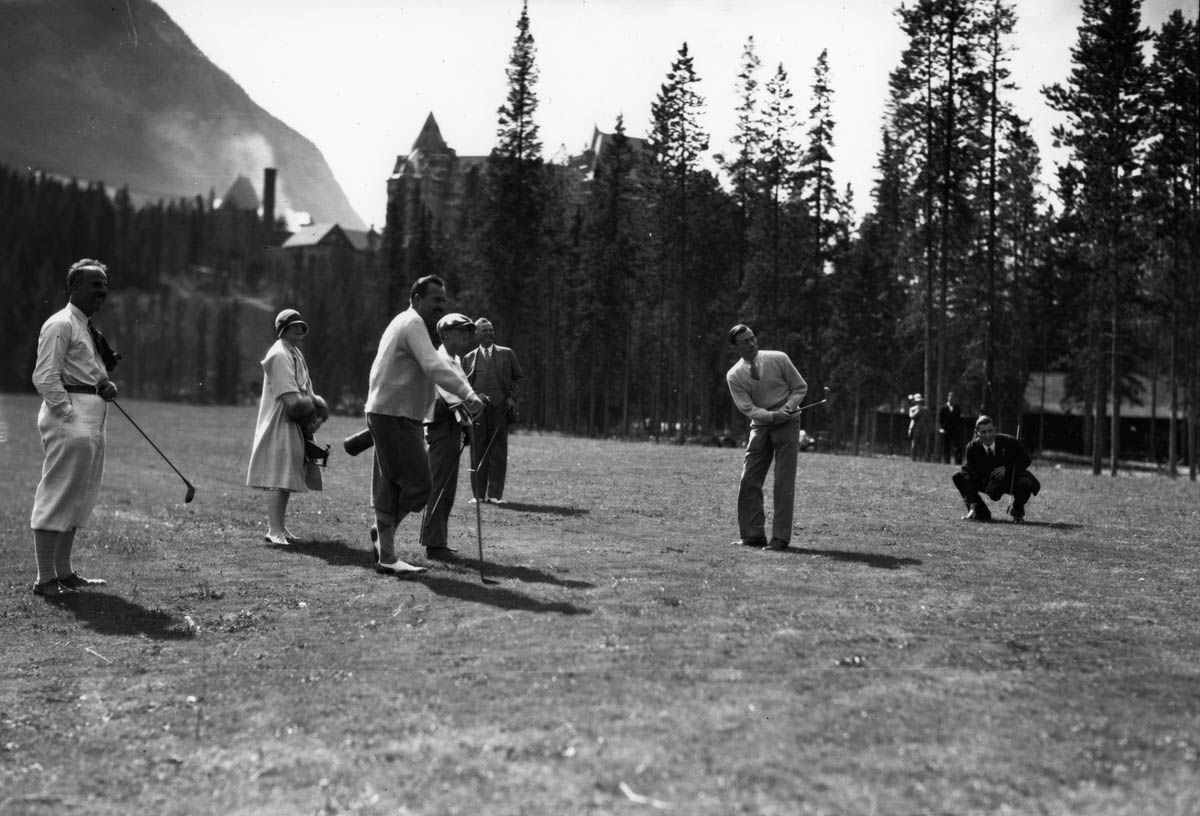
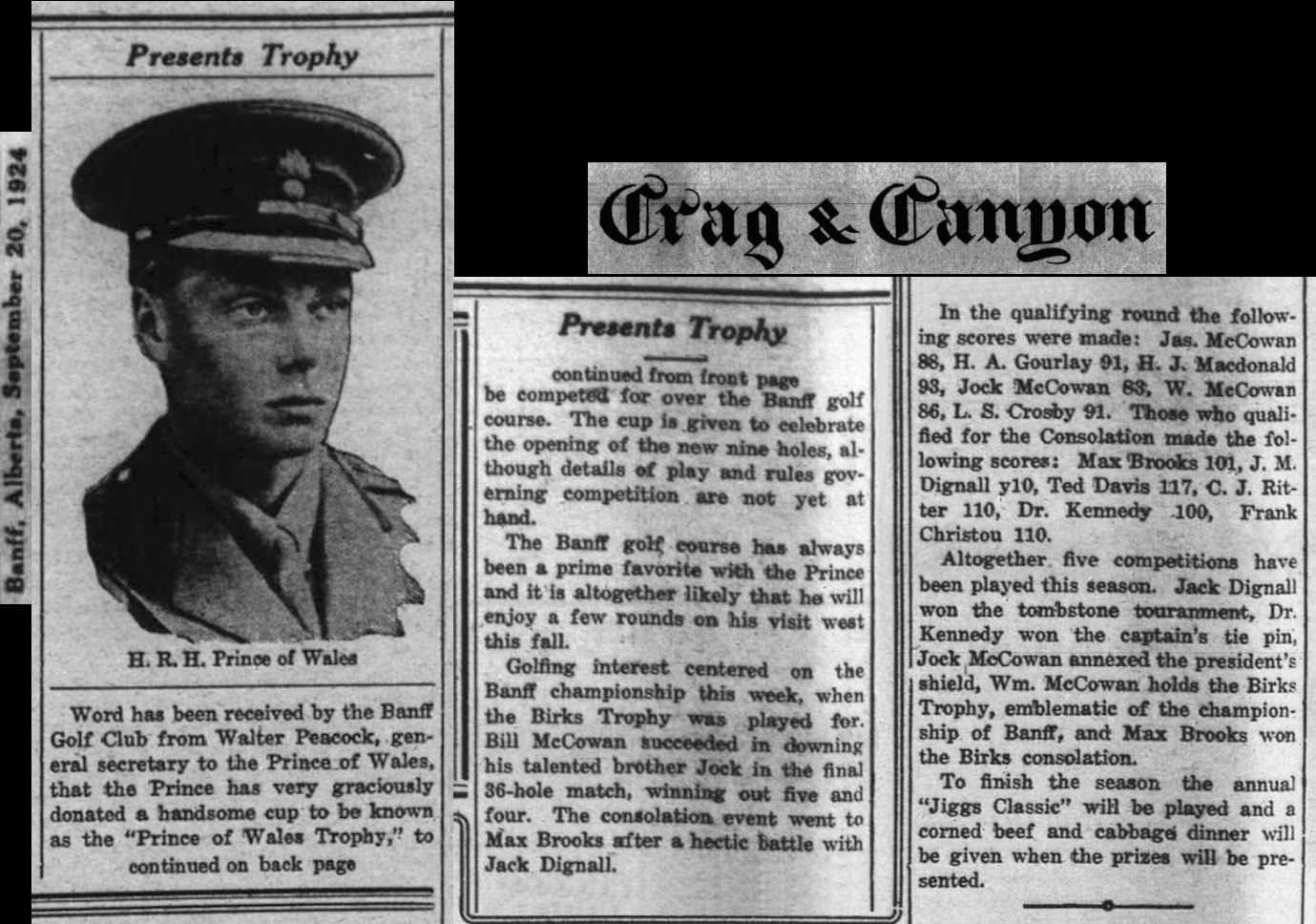
When Edward, Prince of Wales, spent a few days at the Banff Springs Golf Course in September 1923, his equerry, Walter Peacock, developed an infected tooth and was referred to club member Dr. Ernest Kennedy for treatment. Kennedy performed a minor operation to solve the problem, prescribed some pills, and thought nothing more of the matter. He was, however, delighted to receive a letter from Peacock a week later thanking him for his services. Kennedy then took a bold step—on March 24, 1924, he wrote to Peacock at the prince's London residence, York House, St. James Palace:
I received your letter from Winnipeg in due time and was very pleased to learn that you experienced no great unpleasantness following my operating. I have the honour to be the President of the Banff Golf Club, and knowing His Royal Highness' fondness for the game, I would like your opinion regarding the presenting of a request, to His Royal Highness, for a trophy to be played for over the Banff course. Undoubtedly His Royal Highness is pestered with various requests of this nature, hence my desire for your guidance in the matter. Would you be good enough to advise me, or, should it meet with your approval would you be kind enough to bring it to the attention of His Royal Highness for me? We will have a full 18 holes this season and I know a trophy presented by His Royal Highness would be most popular. May I suggest a plan can be evolved by which all visitors to Banff may compete for such a trophy: lowest score for the season to win. The trophy could remain in the possession of the Banff Golf Club and the winner presented with a suitable gold medal, which the Golf Club would be glad to provide each year. The competition could be open to amateurs the world over and thus correctly termed the "World's Amateur Championship for the Banff course."
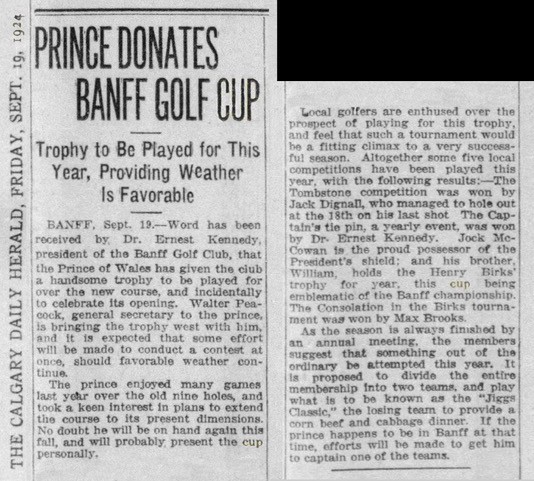
Kennedy did not immediately receive a reply to his letter and undoubtedly thought it had been thrown on the heap of letters requesting such favours. Then, in early August, he received a short note from Peacock stating, “The Prince of Wales is very pleased to give to the Banff Golf Club a small Challenge Cup to celebrate the opening of the full 18-hole course." He indicated that the royal party would be leaving for Canada on August 30 and that he would bring the cup with him. As it turned out, the prince's original plans to visit Banff on the trip were changed, but Kennedy was at the Banff Railway Station to receive the cup from Peacock's hand when the train made a brief halt while passing through on its way to Vancouver at the end of September.
The Prince of Wales Cup donation was a major story in Banff. It was front-page news in the Crag and Canyon and appeared as a news item in newspapers across Canada. When the club held its annual meeting at the Mount Royal Hotel in October 1924, Kennedy proudly presented the cup to the membership for the first time. Within a few days, it was ensconced in the window of Gourlay's King Edward Drug Store for golfers and non-golfers alike to marvel at.
The acquisition of the Prince of Wales Cup by the Banff Springs Golf Club brought a tremendous amount of prestige to Banff in golfing circles. Apart from newspaper coverage, the subject of conversation in Banff was the focus of the 11th anniversary issue of Canadian Golfer, the official publication of the Royal Canadian Golf Association, published in May 1925. The cover of the periodical was adorned by a photograph of the Prince of Wales with the caption, "The Ambassador Of The Empire And An Ambassador Of The Royal And Ancient Game," and its lead editorial began, "The golfers of Banff are very proud of the fact that they are competing this season for possession of a trophy presented to their club by the Prince of Wales."
And most importantly in 1925, the Prince of Wales Cup was put up for competition for the first time and eligibility was extended to any member of the Banff Springs Golf Club or a Calgary club with a handicap of 20 or less. The winner was to be awarded a gold medal, and the winner's club was to take possession of the cup until May 1 of the following season. In early August, R. Morrison of Calgary’s St. Andrews Golf Club won the inaugural Prince of Wales Cup, with a net score of 133 over 36 holes. The best scores posted by Banff Springs Golf Club members were Lorne Orr (137) and Hugh Gourlay (138).
In early 1928, prior to the opening of his new golf course, Stanley Thompson submitted a report and recommendations to CPR officials that mentioned the Prince of Wales Cup. The report dealt with several matters, including the care and maintenance of the course, advertising, and competitions. Under the heading of "Tournaments—Banff Golf Course," Thompson suggested the following:
The Banff Golf Club is in possession of the Prince of Wales Cup (the only trophy of such nature His Highness, to our knowledge, has given in America). Much could be done to exploit a general amateur tournament of International character, with this trophy as the prize. As the Canadian Amateur Golf championship is likely to be played in the West in 1929, you could arrange to play your Prince of Wales tournament at a time when the visitors of Eastern Canada who would be in the West, could attend.
On November 7, 1928, at a meeting with the club’s board of directors and CPR officials, Thompson explained his idea for the future of the Prince of Wales Cup. After much discussion, a deal was made—the club would retain ownership of the Prince of Wales Cup, but the CPR could use it for its own purposes in return for a guarantee of playing privileges for club members on the new course. As the raison d'etre for the agreement between the CPR and club, the Prince of Wales Cup had its own special section in a new Constitution and By-laws. It stated that the cup would be "for annual competition over the Banff Springs Golf Course at a date to be decided each year by the Executive of the Banff Springs Golf Club." The Constitution and By-laws further stated that the competition would be open to bona fide amateur male members of any club in the world, and the mode of play would be an 18-hole medal round followed by the 16 lowest scores being drawn for elimination rounds based on 18 holes of match play. The rules of play would be those of the Royal and Ancient Golf Club of St. Andrew’s, except where modified by local rules.
The first Prince of Wales competition held under the terms of the new format took place in the third week of August of 1930 and attracted several American golfers as well as a stellar field of Canadians. The keen competition attracted large crowds that followed the various matches around the course; the exciting final took place between Dave Arnott of Manitoba and William "Bill" Thompson of Toronto (brother of Stanley Thompson), as reported in the Crag and Canyon:
A six-foot putt separated Dave Arnott of Winnipeg from the Prince of Wales Trophy, coveted prize of the recent Banff Springs Golf Course Tournament, in the last round of the finals. He was one up on the day's play. Both he and his opponent W.J. "Bill" Thompson of Toronto made good tee drives and their seconds landed them on the green, Arnott six and Thompson five feet from the flag. Arnott's ball hovered on the lip of the cup, but Thompson sunk his putt. This evened the match but another hole was played, Thompson winning easily and taking one of the most sought after prizes in Canadian golf.
It seemed fitting that one of the five "Amazing Thompsons," Canada's premiere golfing family, won the first major championship on the course that his brother designed.
Throughout the 1930s and ’40s, accomplished golfers from across Canada and as far away as New York travelled to Banff to compete for the Prince of Wales Cup, with official regulations stating that eligibility was extended to “amateur golfers the world over who are members in good standing of any recognized golf club”—and not surprisingly, they usually beat out Banff Springs Golf Club members. The first time that a member won the tournament was in 1929, when Charlie Reid survived the gruelling week of matches to claim the victory.
Competition for the Prince of Wales Cup went on hiatus after 1948 due to a lack of entries, but in 1973, the tournament was resurrected. The announcement was made with much fanfare in early May 1973, when a delegation travelled to Calgary to hold a press conference announcing the revival of the famous event. The press conference included club president Elmer Charlton, club captain Norman Knight, club pro Malcolm Tapp, and the oldest living club member, Charlie Reid. Reid became the centre of press attention as he reminisced about the history of the tournament and the club:
I remember the day when we made up a foursome and went over to the course for a round of golf. When we got to the club house, the door was closed. We knocked and walked in. There sat the Prince of Wales and his brother, the Duke of Kent. I said: "Pardon me, gentlemen. We're going to change our shoes. They didn't say a word. No snow, no rain nor royal visit was going to interfere with that golf match.
The press conference also indicated how major a decision the CPR considered reviving the event to be. In addition to the 36-hole scratch play for the Prince of Wales Cup, the tournament weekend would include the Chateau Lake Louise Cup for ladies’ play. The entry fee was set at $24.50, which included two days’ green fees and a Saturday night dinner, and the hotel offered an all-expenses-paid weekend package for out-of-towners who wished to participate.
A snowfall forced the cancellation of the 1973 tournament, and it wasn't until May 1974 that Reid had the pleasure of presenting the Prince of Wales Cup to the first winner of the modern tournament, Constable Howie Martin of the Banff RCMP, who carded a 146. The cup was presented to Bob Spence for the last time in 1989 (although the last name recorded on the trophy is H. Krampe, the 1987 winner).
The club’s most famous trophy then went missing. Long-time club member Eddie Hunter began an intensive investigation two decades later and reported in the Crag and Canyon that older members “have vague memories of the Prince of Wales Trophy” but that “club records are lacking information.” Hunter ended his article with the following questions: “Will it ever show up or is it possible someone destroyed it for the silver content? Why did it disappear when the clubhouse and course was changed? Did someone not agree with the new look of the course? Would a reward bring it out? Or is it possible to approach the royal family for a replacement to honour the 100th anniversary?” And then in 2009, between the end of the golf season and the awards banquet, the Prince of Wales Cup inexplicably and unexpectedly appeared in the clubhouse trophy cabinet, where it remains to this day.
Willingdon Cup
In 1931, Lord Willingdon, the former governor general of Canada, donated a cup for play on the Banff Springs Golf Course. (In 1927, Willingdon also donated a cup to the Royal Canadian Golf Association for competition between teams of male golfers from each province; the Willingdon Cup is now held in conjunction with the Canadian Men’s Amateur Championship). Both he and Lady Willingdon were keen proponents of the game and although fairly elderly had played rounds in Banff on several occasions during viceregal visits. The last of these occurred when the Thompson course was still under construction in 1928, and they expressed their opinion that it would be one of the finest on the continent. Undoubtedly wanting to have his name associated with such famous links, Willingdon provided a cup for an amateur championship before departing for India, where he had just been appointed viceroy.
The inaugural Willingdon Cup was held between August 17 and 22, 1931. It was open to members of the Banff Springs Golf Club or amateur players who were guests at the Banff Springs Hotel. Banff Springs Golf Club member Frank Christou reached the semi-finals of the first Willingdon Cup, and Lou Crosby won it in 1932 by defeating his clubmate Reg Coysh 8 up on the 29th hole (Crosby also won the cup in 1933). The women’s division of the Willingdon Cup was replaced by the Associated Screen News trophy in 1933. Local members who claimed this title included Marguerite Rutherford (1935), Ethel Knight (1939), and Marion Crosby (1941).
The tournament was beefed up with additional events to make it more interesting and enjoyable for golfers of lesser skill or those eliminated earlier. These events included approaching and putting competitions, mixed foursomes, tombstones, driving competitions, men's handicap against par, and a unique event called the "kicker's handicap," in which the winner was the player who registered the score closest to one sealed in an envelope. The trophy presentation also became a focal social event, held at the Banff Springs Hotel on the evening of the final; a luminary hosted the event. In 1932, for example, Crosby received his Willingdon Cup from Thomas Murphy, the minister of the interior, at a ceremony hosted by CPR vice-president Dalton Coleman.
Golf Week
In the early 1930s, John Murray Gibbon, a CPR promotion agent, struck on the idea of creating special weeks for golf at the Banff Springs Hotel that would provide an attraction for golfers similar to the backcountry pack trips provided to trail riders by the Trail Riders of the Canadian Rockies and to hikers by the Sky Line Trail Hikers, two annual events also introduced by Gibbon. These weeks were initially centred on the prestige of the Willingdon Cup and the CPR’s negotiated access to the Prince of Wales Cup. The initial Golf Week in 1934 was a resounding success for the CPR, both promotionally and financially, and Golf Week remained a major focus of the CPR's advertising campaign well into the 1940s. An all-inclusive tournament rate was offered by the railway—$168.00 from Toronto, including a first-class rail ticket, transfers from the Banff Railway Station, accommodation and meals at the Banff Springs Hotel, seven days of green fees at the Banff Springs Golf Course, and competition entry fees. A special brochure advertising "a full week's competitive golf played on the roof of the world," complete with a schedule of all events, fees, and rates, was produced and circulated to travel agencies and other golf clubs across Canada. The events received good media coverage and were followed with interest around Canada. For example, the July 1935, issue of Canadian Golfer spoke of Golf Week and stated that "every golfer should note it in his diary":
The Prince of Wales trophy competition at the golf course of the Banff Springs Hotel will be played August 26 to August 31, and as in other years, will attract golfers from practically everywhere on the continent and even from Europe. There is a thirty-six hole qualifying tournament to start off, and then follows the match play over the same number of holes for the survivors. What these players will face is by no means part of the ordinary run of golf courses! Instead, something entirely unique, not only for scenery which is unapproachable in all the length and breadth of Canada, but also in the hazards which combine pretty nearly everything. Too, there is the wild life in the Mountains which have a quaint habit of invading the golf course but not to the extent of interfering with the game.
Although tourism in Banff was affected by the onset of World War II, the CPR pressed ahead with the plans for Golf Week in 1942. Although the company planned for more than 200 golfers to participate, this was undoubtedly wishful thinking for pre-war numbers. Subsequently, the CPR decided it would close the Banff Springs Hotel for the duration of the war and Golf Week was cancelled (although the course remained open). Golf Week was briefly revived after World War II, but the concept was abandoned in 1947 due to a combination of waning interest and a lack of availability of space at the hotel.
Shell's Wonderful World of Golf (Watch this episode)

In September 1961, Banff was chosen to be featured on Shell's Wonderful World of Golf, the first major television program featuring competitive golf. Matches were to be filmed at the top 11 scenic golf courses in the world, and the program was to be broadcast worldwide.
The series commentator, Gene Sarazen, was not unfamiliar with the Banff Springs Golf Course, as he had played an exhibition match on it during the height of his career, in July 1936, against ladies’ champion Helen Hicks. (Sarazen’s original visit was marked by his inability to judge distances in the mountain surroundings—an inability in which he was not alone. On one hole, he apparently only used half the iron he needed to reach a green, despite his caddy's advice.) By 1961, he had retired from the professional circuit, but he was considered the doyen of American golfers and NBC's regular golf broadcaster. The Banff match featured Stan Leonard against Jackie Burke Jr. At the time, Leonard was one of Canada’s best golfers and had won the Canadian championship eight times. Having experienced one of his most satisfying triumphs in Banff 13 years earlier, when he defeated Bobby Locke in an exhibition match, the Canadian was also familiar with the Banff course. Leonard’s opponent, Burke, was a young Texan golfer who, remarkably, had been born on the very day that Sarazen had lost the PGA championship to his famous father, Jackie Burke Sr., in 1924.
In a pre-game interview, Burke drew laughs when he opened with, "I usually start speeches by saying a few words about Texas." However, he did have words of praise for the Banff course, stating, "This place is something I'm never likely to see again. It's wonderful." As it turned out, Leonard became the centre of attention during the match and earned the moniker "Mr. Personality" from the press. He joked freely with the gallery during the filming and even performed a few impersonations of other golf greats during lulls in the action to keep the crowd entertained. His relaxed attitude stood him in good stead, and he fired a sizzling two under par 69 to beat Burke by five strokes. He walked off the 18th green after four days of filming with $3,000 in prize money—and one more reason to count the Banff Springs course among his favourites.
Shell's Wonderful World of Golf series did not air until 1962, as there were several matches to be filmed after Banff at such famous courses as Pine Valley in New Jersey, St. Cloud in Paris, and St. Andrews in Scotland. When the advertising for the series began, it featured a cartoon of Sarazen hitting a golf ball globe with a "Banff" pennant in the northern hemisphere and "Melbourne" and "Kasumigaseki" pennants in the southern hemisphere. This advertisement appeared in newspapers across all markets where the series was shown, and it was estimated that 40 million viewers watched each episode. This was exposure for the course beyond the CPR publicity department's wildest dreams, and it was no wonder that, in April 1963, hotel manager Walter Harvey happily accepted a complimentary copy of the film from Shell Oil, with the intention of showing it to hotel guests throughout the tourist season.
Rob Roy Trophy
In the early 1970s, there was a feeling among both the club’s directors and course management that some of the aspects of the glory days of golf in Banff had disappeared. In attempting to re-capture some of the excitement and widespread publicity of the old Golf Week, the Banff Springs Hotel decided to hold a new competition in conjunction with the opening of their Rob Roy Dining Room. Competition for the Rob Roy Trophy was initially held on October 7, 1972, using an 18-hole low-net medal-play format and consisted of both men's and ladies’ competitions. The first trophies were won by Cal Rowan of Jasper in the men's and Doris Bray of Banff in the ladies’. The event proved so popular that it was quickly extended to a two-day (weekend) 36-hole format, and by the late 1970s, it was attracting about 140 participants annually. While the women of Banff continued to do well in the event, the men’s division winner was often from out of town, except in 1978, when Jack Wilson won.
Telus World Skins Games
In 2006, the Banff Springs Golf Course hosted some of golf’s most famous names when Jack Nicklaus, Greg Norman, Stephen Ames, John Daly, and Sergio Garcia teed it up for the two-day Telus World Skins Game, an annual event in Canada since 1993. The 2006 edition was the first in which five players competed (previously only four took part); each chosen golfer represented a different decade. For the event, the course was played in its original rotation; players were introduced on the original 1st tee box, high above the Spray River, by town of Banff mayor and club member John Stutz.
As a tribute to the earliest days of golfing in Banff, the five players used hickory clubs at the Devil’s Cauldron. Jack Nicklaus, who was most comfortable with the old clubs, hit a shot that settled under three metres (nine feet) from the hole. A spectator on the tee box commented that it sounded like it was miss-hit. Nicklaus calmly looked to the crowd and said he was between clubs and that he was going to “hit the extra club a little off centre to deaden the shot into the hole”—and no one was going to argue with that! A few moments later, Sergio Garcia, the youngest of the fivesome, fired his ball to the back of the green, from where it spun back and lipped out for a hole-in-one.
Golf writer Ian Cruickshank‘s fondest memory of the Banff Springs Golf Course is of the Skins event and the tee shots on Thompson’s famous 1st hole. “As the legends peered out over the cliff,” he recalls, “they began to grin like little kids on a Christmas morning. Mesmerized by the spectacular site, the fabulous fivesome launched their drives into the horizon and the golf balls seemed to rise as if they were helium balloons, eventually tumbling like shooting stars more than 300 yards down the fairway, as the gallery whooped and hollered in appreciation. As the group wound its way down from the cliff top to the fairway, it was easy to see why the Banff Springs is Stanley Thompson’s most famous work.”
Calgary resident Ames won $95,000 on the first day of competition, and on the following afternoon, the crowd roared with wild abandon when larger-than-life John Daly sunk a birdie putt on the 15th hole to win $135,000 and then sealed his place as overall winner by claiming a $25,000 skin on the 18th hole. But the sentimental favourite was Jack Nicklaus, whose presence alone proved a memorable experience for all in attendance.
In 2011, the Telus World Skins Game returned to Banff, with Steven Ames hosting again, and this time Jhonattan Vegas, Luca Glover, Anthony Kim and Paul Casey as the other competitors. This time the pros played the current, regular rotation. Among the fun elements of this year’s tournament was Paul Casey (a little upset with his play), challenging the others in the field to “throw their ball” off the tee rather use their clubs on the Par 3, 8th hole over the water hazard!
On day one, playing on a rain-soaked course, Vegas surged into the lead winning $55,000 in skins. On day 2 he recorded the first birdie and then sunk a 20-foot putt on 13 to grab an additional four skins for a further $85,000. Also, on Day 2 after much overnight rain which cancelled the morning Pro-Am and submerged the driving range, Lucas Glover scored the only eagle of the tournament with a 30 foot putt on the 18th hole to earn 5 skins and $125,000.
Vegas won with $140,000, Glover was runner-up with $125,000, followed by Ames (45,000), Kim ($30,000), and Casey ($20,000 – but a terrific throw off the 8th tee!).